Beyond the Sketchpad: The Designers Who Shaped the Hyundai IONIQ 3
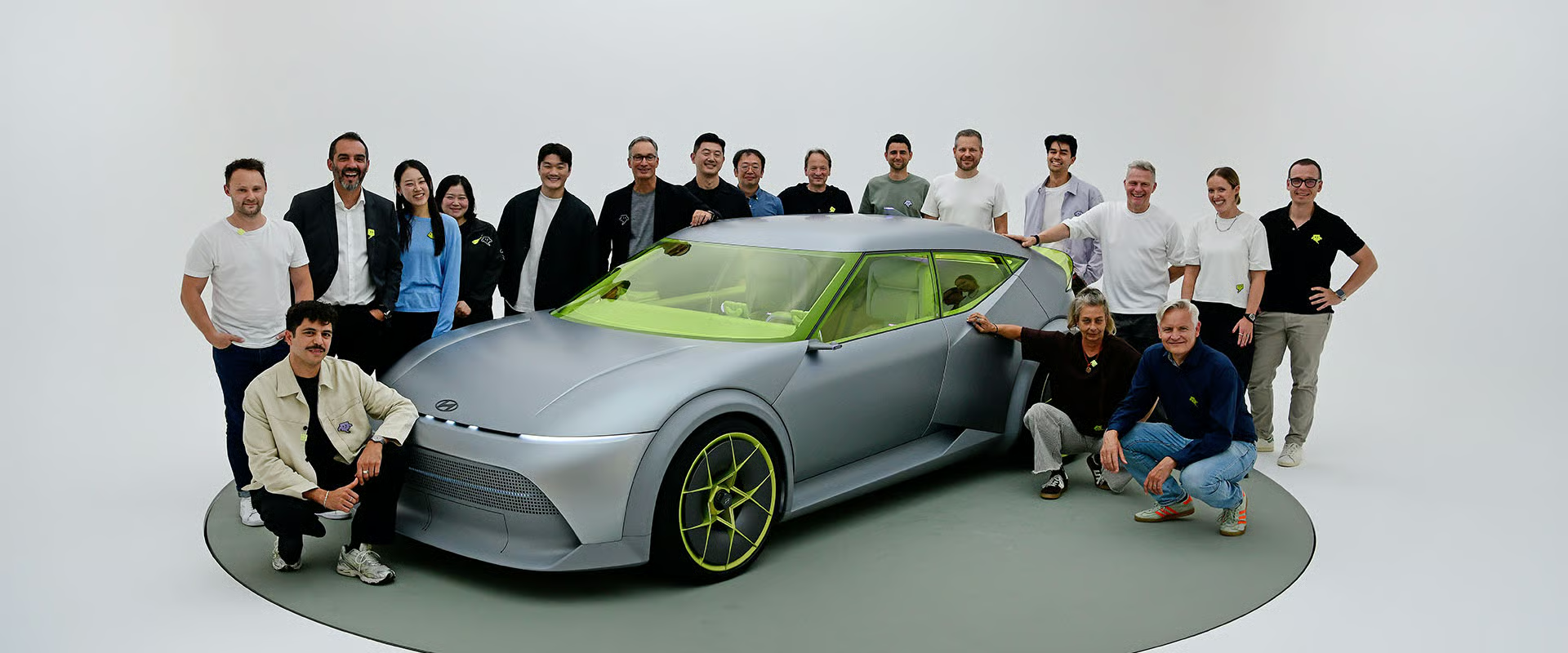
Hyundai Motor unveiled the IONIQ 3 at IAA Mobility 2025 in Munich — its boldest take on electric mobility yet, and the first compact electric vehicle (EV) concept to wear the IONIQ badge.
Compact in footprint but striking in form, the IONIQ 3 embodies Hyundai’s new ‘Art of Steel’ design language. More than a styling exercise, it’s a statement of intent: mobility that is democratic and emotional, functional and forward-thinking.
So how does a vision like this take shape? What does it tell us about the next chapter in Hyundai’s design story — and who exactly is ‘Mr. Pix’?
To answer those questions, we spoke with the team behind the car:
- Simon Loasby, Senior Vice President and Head of Hyundai Design Center
- Nicola Danza, Head of Exterior Design at Hyundai Design Center Europe
- Raphael Bretecher, Head of Interior Design at Hyundai Design Center Europe
- Emilie Grimm, Advanced CMF designer, Hyundai Design Center Europe
Together, they lift the lid on the creative process and share the ideas that shaped IONIQ 3.
Before we dive into the details of the Hyundai IONIQ 3, can you give us a brief overview of Hyundai’s new design language, ‘Art of Steel’?
Simon Loasby: ‘Art of Steel’ began with a conversation I had with SangYup Lee (Executive Vice President and Head of Hyundai and Genesis Global Design). He pointed out that Hyundai is perhaps the only car manufacturer that produces its own steel, giving us a uniquely close relationship with our colleagues in manufacturing.
That sparked the question: how can we celebrate steel? And if we do, how can we design something that not only looks like steel but also expresses the best qualities of the material? In a way, ‘Art of Steel’ is about the artistry of curving, bending and moving steel to create volume.
Nicola Danza: When you look at steel coils in the factory, you notice how gravity alone bends and folds the material, without any added pressure. Even with the gentlest bend, you see these highlights emerge. It’s beautiful — the way steel naturally reacts and forms.
In what ways does the IONIQ 3 embody the ‘Art of Steel’ design language — how is it expressed in the bodywork and surfacing?
SL: We started with paper sculptures. We asked the designers to truly consider how to use a material in its most natural form. And a quick simulation of that can be achieved using paper. The team studied form, tension and flow of the material to generate the shapes you see on IONIQ 3.
ND: From there, we experimented with steel models to find new inspiration. When we gently bent the steel, it resulted in some nice simple highlights. But simple can become boring, so we introduced three intersecting bends — across the front fender, the door, and the C-pillar — which created layered planes and highlights.
By combining the natural evolution of the material with sharper, more deliberate lines, we were able to give the IONIQ 3 a real sense of tension.
What was the inspiration behind making the IONIQ 3 a hatchback?
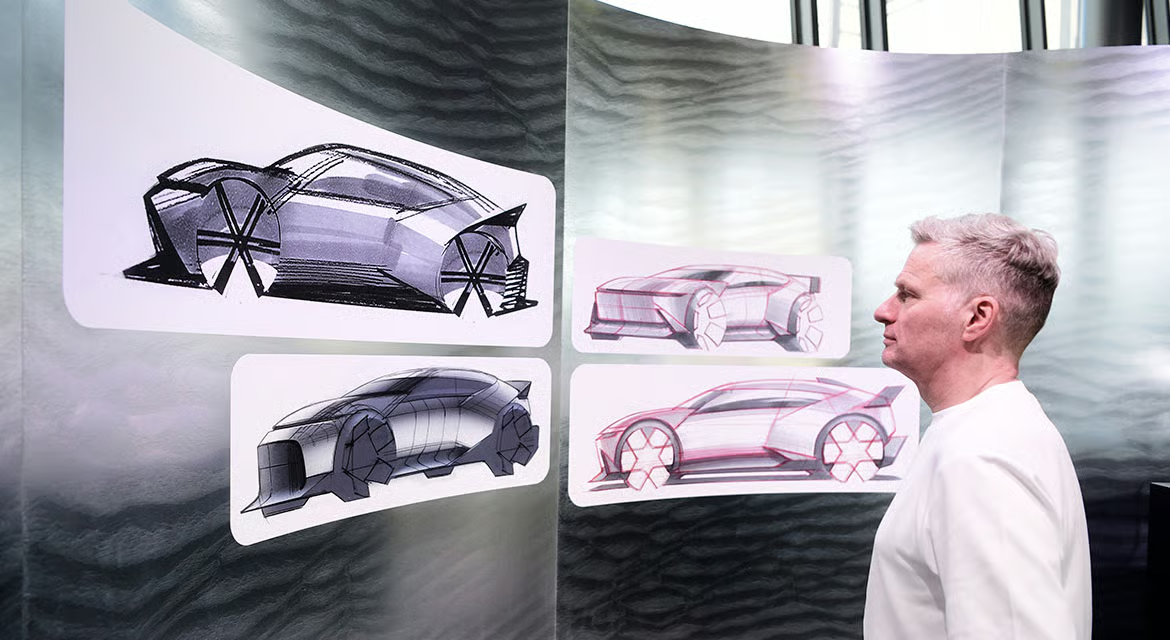
SL: The design of IONIQ 3 started with a challenge from SangYup and me to the European Design team. In Europe, you see all these fantastic hatchbacks — so how do we compete?
We started with side view silhouettes. I still remember a late-night video call — I was in Seoul and Eduardo Ramírez (Chief Designer of Hyundai Design Europe), Nicola, and Manuel ‘Manu’ Schoettle (Exterior Lead Designer, Hyundai Design Europe ) were in Europe. One silhouette just jumped off the screen. We called it the ‘Aero Hatch’.
The silhouette starts low at the front for aerodynamic advantage, then rises into a distinctive roof profile with an acceleration point just behind the rear passengers, giving them maximum headroom. From there, it flows down into a bold ducktail spoiler. And really — who doesn’t love a ducktail spoiler?
The result is aerodynamic efficiency and a hatchback with its own unique typology.
ND: At Hyundai, every model presents us with a chance to invent something new, tailored to the segment and the customer’s needs. Hyundai models don’t share a single face, and that’s intentional.
For us designers, the most exciting part is when we’re not tied to the same set of parameters every time. That freedom allows us to explore fresh ideas, new design languages, and even new faces for the brand.
We’ve noticed a certain character, Mr. Pix, hiding in different locations all over the IONIQ 3. Can you explain who he is?
SL: In design, we always ask: how can we put a smile on someone’s face? After creating ‘The Boost’ character for INSTEROID, we challenged the team to imagine a character for this car. They chose to celebrate the pixel, which became ‘Mr. Pix’ — a playful little figure who shows up in the clusters, head-up display, screens, instrument panel ends, and even the pixel board up front.
There are Mr. Pix screw heads in the rear ‘exhaust’ loudspeakers, too. I couldn’t tell you how many times he appears on the car. The designers have just been having fun with it, and it’s become a story people enjoy discovering.
ND: We added a lot of small details that you might not notice at first, but then they catch your attention. They add real value to the design.
We all know what the words on the diffuser refer to [‘May The Downforce Be With You’, Ed]. It’s both functional and fun. We need the downforce, but we also want to show we’re creative people, not just executing a function.
Can you walk us through the design of the IONIQ 3’s dashboard. It looks quite unlike anything we’ve seen before.
SL: The interior architecture is all about safety — keeping the driver’s eyes on the road and hands on the wheel. That’s why we’ve raised the driver information above the steering wheel, as close to the eyeline as possible, and positioned it slightly further away to make it easier to focus on.
Raphael Bretecher: We’ve also clustered the small screens in the IONIQ 3 around the steering wheel, so they’re right at your fingertips. You don’t want to be searching through a screen for a basic function. That’s why screen reduction is so important.
Is it a challenge to create such a vibrant interior using sustainable materials? Are there any new or unusual materials featured in the IONIQ 3?
RB: My favorite material is visible at the ends of the doors and along the dashboard — aluminum that is almost like a foam. It has a striking visual quality, but it’s lightweight and contributes to the door’s structure.
SL: I have to compliment Emilie and the CMF team on the positivity of the color and trim. It really lifts you — it’s like a summer day.
Then there’s the special metallic-finished leather, which exists only in a single-plane curvature to give the impression of sitting in a furnished space — we call it the ‘Curve of Upholstery’. We’ve also used wool as a fabric, which is sustainable and recyclable. Sustainability being one of the key pillars of IONIQ.
Emilie Grimm: Because it’s a concept car, we don’t have to put the materials through the same testing as a production model. That means we can showcase innovations such as aluminum foam, UV-absorbing, yellow-tinted glass, and seat trims made from recycled ocean waste — a material we currently only use for carpets and floor mats in production cars. And if you look at the floor, you’ll see a special paint finish that uses recycled aluminum powder.
On the topic of design details, what is your favorite on the IONIQ 3?
SL: I love how the surface of the rear window rolls over the pillar, flows downward, and becomes the door. I can imagine a single piece of steel wrapped around to create that surface, intersecting beautifully with the rear above the bumper. It’s a single-plane curvature — a concept straight from Manu’s first sketches.
RB: There’s an illuminated battery area in the center of the floor. You have to get close to notice it — it’s subtle, but beautiful when you do.
ND: The ducktail. Specifically, how it flows into the bumper shut line — that idea came from Manu. We wanted something sporty, but not aggressive — just a gentle touch. There are many details I love, but that one really gives the car a sense of dynamism.
EG: My favorite design detail has to be the aluminum foam in the doors. It’s a very lightweight, rigid material that doubles as a structural element, enhancing the strength of the doors while giving them a distinctive look.
Simon, can you sum up how the IONIQ 3 reflects Hyundai Motor’s vision for the future of electrification?
SL: IONIQ 3 stretches the bandwidth of electrification. It positions us for a production vehicle in a more compact, lower-cost segment, so that everyone can enjoy IONIQ.
And you know what's even cooler? Just like with the SEVEN concept, the production car will be even more impressive. IONIQ 3 is exciting, but when you see the production version, you’ll think, “Wow — it’s even better.”